Platform
Everything a scrap yard runs on, in one product
The counter, the rules, the prices and the sale share one record and one sign-in. Everything below runs in production unless it is marked Built, In development or Planned.
The counter
The point of sale is one screen on the yard iPad, installed from the browser and approved by the owner before it can take a ticket. Weights are typed on a keypad sized for gloves; the server prices every line and checks every rule.
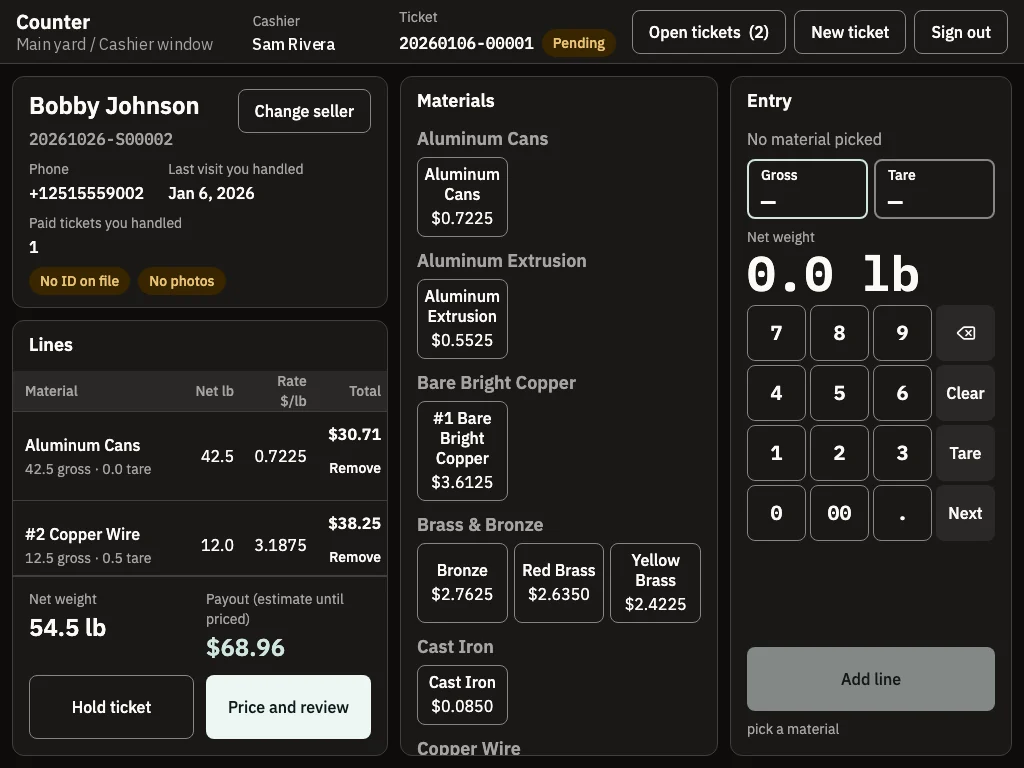
Seller, lines and weights on one screen
- 1Find the seller or add one at the counter, ID fields and two photos taken in place
- 2Tap a material: the tiles show only what the yard prices today
- 3Gross and tare on a keypad sized for gloves; net computed as you type
- 4Correct a line before pricing; hold the ticket and pick it up at any station
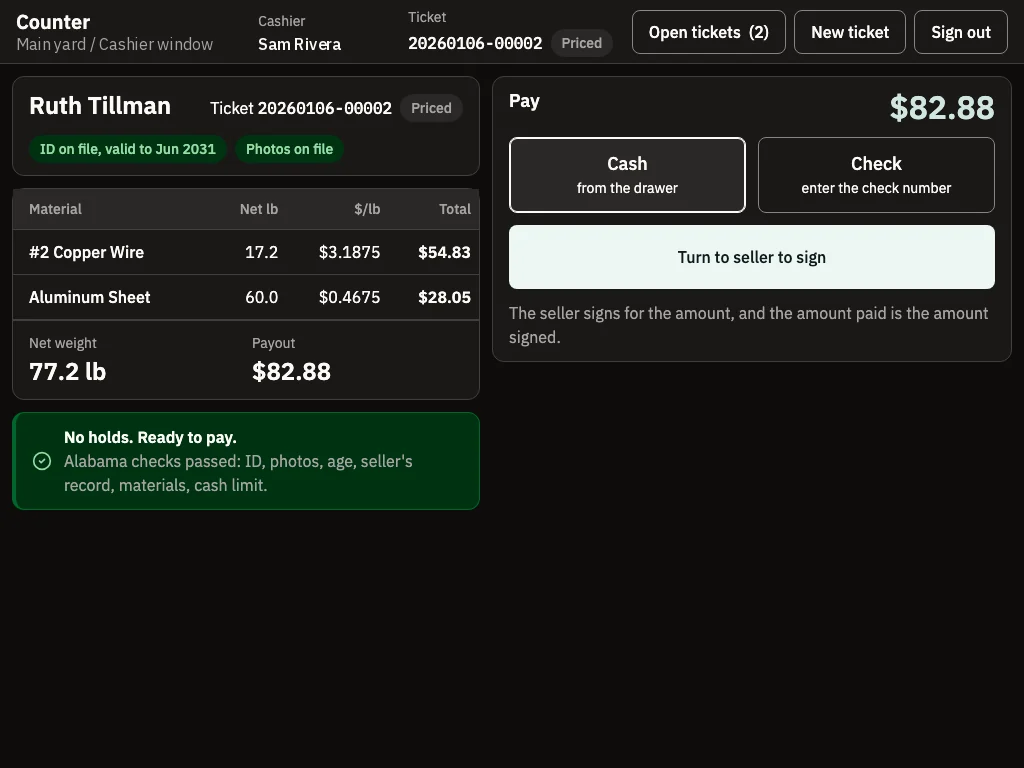
The holds, by name, before any money moves
- 1Every check the state requires, run at pricing and again at payment
- 2A hold names the field and the fix: take photos, enter the birth date, pay by check
- 3Cash or check, with the state cash limit checked on every ticket
- 4Two people, one ticket: claim, release, take over and pay
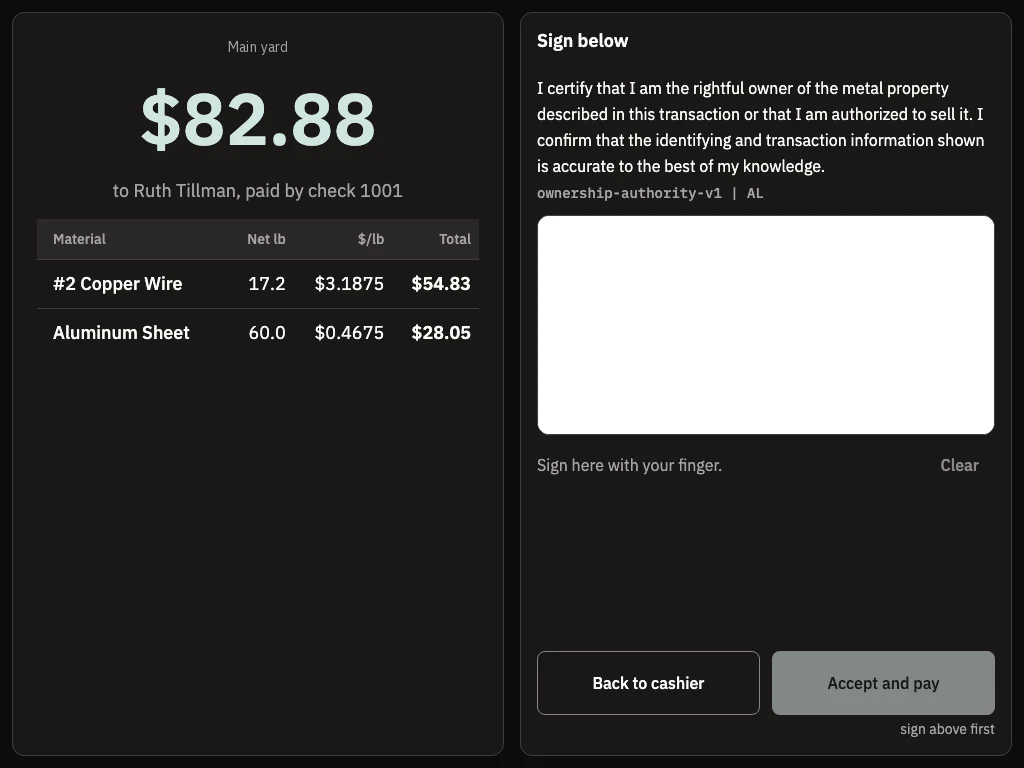
The seller signs for exactly what is paid
- 1The iPad turns: the seller sees the amount, the lines and the attestation
- 2The signature is bound to the priced snapshot and the rule version
- 3The amount paid is the amount signed; the receipt is immutable
- The seller copy prints from the bar, and reprints are recorded
Compliance
Rules as data with their statute, holds that name the fix, attestation bound to the payout and an audit trail.
Rules as data, with the statute
Hold periods, signature, ID and cash limits per state, each with its citation, shown read-only to staff. Alabama runs today; other states are rows, not rewrites.
Holds that say what to do
A missing birth date, an expired ID, missing photos, a prohibited material, a cash payout over the limit: each hold names the field and the way to clear it.
Attestation bound to the payout
The seller's attestation records the final amount, the rule version and the payment method, so the record shows what the seller agreed to.
An audit trail people can read
Releases need an author and a reason; violations are resolved, not deleted; paid tickets and sellers cannot be deleted at all.
Reports for a period
Draft a compliance report for any period from the same records. Filing with an authority is not connected yet, and the product says so.
Pricing
A catalog that speaks scrap, and a server that is the price.
A catalog that speaks scrap
Ten families from ferrous to electronics, 49 materials from #1 bare bright copper to high-grade circuit boards, with grades under each.
The server is the price
Base prices, grade multipliers, seller tiers and owner-approved overrides resolve on the server, which quotes every line for the ticket's seller.
History and trend
Every price change is kept, with seven-day trends, and the yard can publish its price list on its own public site.
Selling upstream
What you buy at the counter, sold for what it is worth: buyer sheets mapped to your grades, prices fixed on the load, settlement with the variance shown.
Buyers' price sheets, mapped to your grades
BuiltUpload a buyer sheet, review how each line maps to your catalog, approve it, and keep every version by its effective date.
Prices fixed when the load leaves
BuiltApply a buyer sheet to a load you are building; the buyer, the date, the weights and the agreed prices are fixed at departure.
Settlement with the variance shown
BuiltAccepted weights, deductions and the variance from what shipped, revised only with a reason, and incoming receipts matched to the load.
Smart melt
In developmentKnowledge of the metal applied to the sale: what each grade is, what it is worth to each buyer, and what to do with it next.
Operations
Stock, loads, pickups, sellers, staff, devices and the yard's own website, from the same records.
Stock from what you buy
Every paid line becomes a stock item at the receiving location; move it, change its status, build and ship loads.
Pickups and routes
Sellers request pickups; dispatch assigns them to routes and drivers, and a collected load arrives as a normal ticket.
The seller portal
A seller sees today's prices at their tier, their tickets and receipts, and asks for a pickup.
People and time
Invitations with the role set first, a time clock with breaks, approved timesheets and a payroll export.
Devices you approve
A counter iPad registers and waits for the owner to approve it, assign it a station or revoke it.
Your own public site
The yard's site with its prices, hours and announcements, run from the same platform.
Engineering
A scrap ticket is a payment and a legal record. The system is built so neither can be quietly rewritten.
One product, one codebase
The counter, the office, the seller portal and the yard site are one product with one sign-in, built together from the first line.
Records that cannot be rewritten
Payment-backed receipts are immutable; paid tickets cannot be deleted; money and legal records are read-only even to administrators.
Tenant isolation, proven
Every read and write is scoped to its yard, and isolation is tested in both directions on production.
A contract, not a guess
A generated API contract and typed clients, idempotent writes, and a release gate that photographs each role's screens on the yard iPad.
Where each part stands
Live runs in production for a yard; Built is in the code and not yet released; In development is being built now; Planned is decided and not started.
Running in production for a yard.
- The counter on managed yard iPads
- Cash and check payouts with state limits
- Compliance holds, attestation and audit
- Grade-aware pricing and price history
- Inventory, loads and shipments
- Pickups, routes and drivers
- Seller portal and the yard site
In the code, not yet released.
- Buyers' price sheets and load pricing
- Buyer settlement and receipts
Being built now.
- Smart melt
Decided, not started.
- Drawer sessions for cash
- Accounting intake from QuickBooks Desktop
- Compliance holds refused at the server as well as the counter